How Long Is Survivor Filmed? 39 Days vs the 26-Day New Era

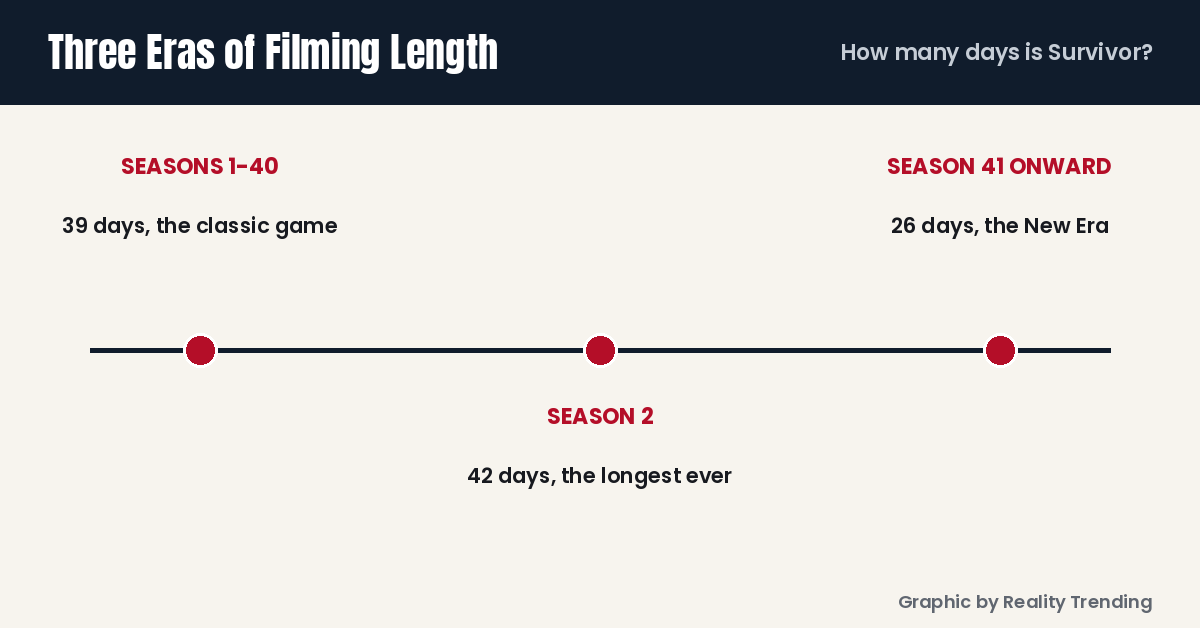
If you are asking how long is Survivor filmed, the short answer depends on which era you mean. Classic Survivor lasted 39 days. The New Era, which began with Season 41, lasts just 26 days. The only exception to the classic run was Season 2, Survivor: The Australian Outback, which ran for 42 days and remains the longest season in the history of the US show.
That 13 day cut changed more than the calendar. It changed how fast players must form alliances, how little food and comfort they get, and how little room there is for a slow start. This guide explains how many days is Survivor in each era, why the change happened, and what the shorter game actually feels like for the people playing it.

How Many Days Is Survivor? The Quick Answer
For most of the show’s history, the answer was 39 days, and the survivor 39 days format is still how many longtime fans remember the show. Seasons 1 and 3 through 40 all used that length, with Season 2 as the lone 42 day outlier. Since Season 41, the answer has been 26 days. That shorter format has now been used for every regular season from Season 41 onward, including the current era covered in our Survivor 51 Hub.
Those counts mean game days on the island, from the start of play through the final Tribal Council. They do not include travel, quarantine, or production setup time.
The 39 Day Era: Seasons 1 to 40
The original format gave players 39 days to outwit, outplay, and outlast each other. That length became so familiar that many longtime viewers still think of it as the normal length of a Survivor season, even though it has not been used for a regular season since Season 40, Winners at War, in 2020.
Thirty nine days gave the game a slower rhythm. Players could settle into camp life, build shelters, and learn who to trust before committing. Alliances formed slowly, a quiet player could wait for the right moment, and an early target could sometimes survive until attention shifted elsewhere.
The classic game was still harsh, with scarce food and constant social pressure. But the longer schedule meant more days between turning points, more time for relationships to deepen, and a slower burn for viewers, with camp life getting more room alongside strategy.
The 42 Day Exception: Season 2 in Australia
Season 2, Survivor: The Australian Outback, is the one season that broke the 39 day pattern in the other direction. It lasted 42 days, three days longer than the standard season, and it remains the longest US season ever filmed.
Filmed in Queensland, Australia, around the Herbert River area, it aired in early 2001. The extra days followed the success of the first season, Borneo, to give viewers something different. The season also saw the show’s first medical evacuation, when Michael Skupin fell into a fire and burned his hands.
Season 2 never started a trend. Every season after it returned to 39 days for nearly two decades.
The 26 Day New Era: Season 41 to Today
The change to survivor 26 days began with Season 41, which premiered in September 2021. Host and executive producer Jeff Probst has explained it plainly: COVID-19 rules put the cast and crew inside a bubble, with quarantine on arrival in Fiji, while production wanted to film two seasons back to back.
As Probst told Entertainment Weekly before Season 41, filming two 39 day seasons back to back, plus a 14 day quarantine, would have meant nearly 100 days in the bubble, and that was simply too long. Cutting each season to 26 days made the back to back schedule workable. What started as a practical solution then became permanent. Probst later said the new era format was here to stay, and every regular season since has kept the 26 day length.
That matters for modern viewers: recent seasons are a compressed game, not a shortened edit of the old one, with challenges, twists, and votes designed around the shorter clock.
39 Days vs 26 Days: A Side by Side Comparison
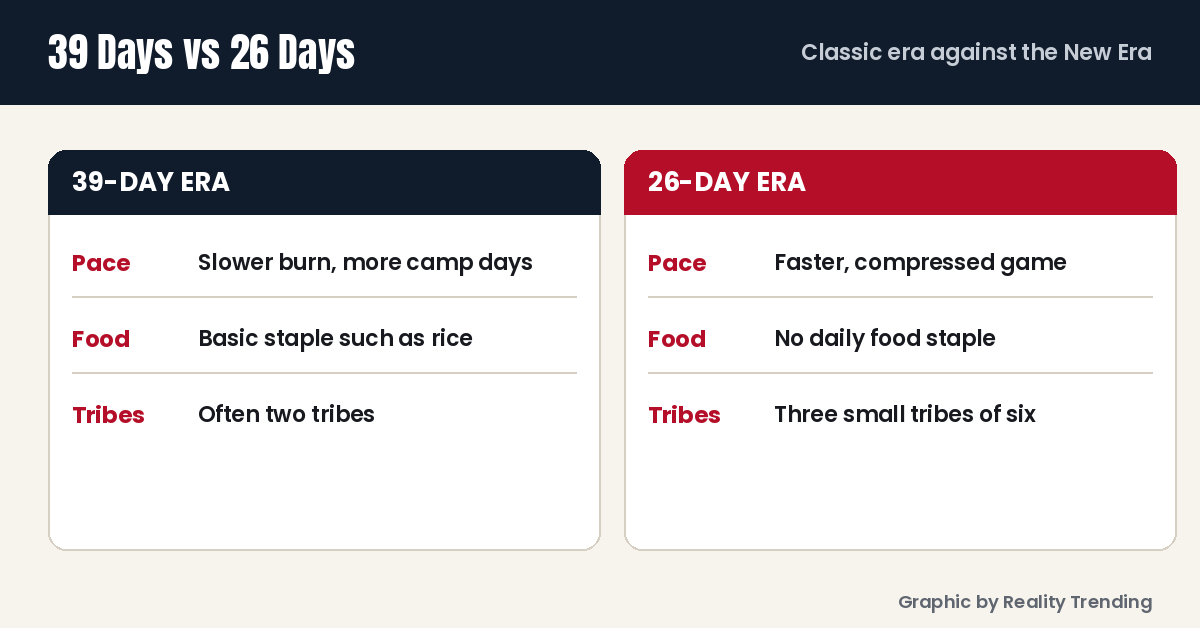
| Feature | 39 day era (Seasons 1 to 40, except Season 2) | 26 day New Era (Season 41 onward) |
|---|---|---|
| Game length | 39 days | 26 days |
| Longest season | Season 2 at 42 days sits outside this standard | No regular New Era season has gone longer than 26 days |
| Starting tribes | Varied by season, often two tribes | Season 41 began with three small tribes of six |
| Food and supplies | Limited, but seasons typically included a basic food staple such as rice | No daily food staple in Season 41, with scarce rewards by design |
| Pace | Slower burn, with more camp days between votes | Faster and more compressed, with less downtime |
| Penalty for losing | Varied by season | In Season 41, a tribe that lost immunity also lost its flint until it won again |
| Why this length | The established format for the show’s first 20 years | COVID bubble and quarantine logistics, then kept as the permanent format |
The table shows why the day count is not just trivia, and why the survivor 39 days era felt so different from the modern game. Thirteen fewer days is about a third of the classic game removed. To keep the shorter game feeling as hard as the longer one, production changed the conditions around it, not just the calendar.
What the Shorter Game Changed
The pace got faster, on purpose
Probst described the New Era pace as relentless, and said players had to assess and reassess their options constantly because there was no time to sit back and contemplate. In a 39 day game, a player could afford a quiet episode or two. In a 26 day game, a slow start is far more dangerous. Alliances need to form quickly, and a player without connections in the first few days can become an easy early vote.
For viewers, this means fewer slow camp days and more votes packed into each stretch of episodes. The season still airs a full run of episodes, but the in-game days pass more quickly, which is one reason modern seasons can feel crowded with twists.
Life at camp got harder, not easier
A common misunderstanding is that fewer days must mean an easier game. Probst pushed back on that idea directly, arguing that the New Era is, if anything, more difficult because players survive with very little food, and in some cases no food at all, from the start. The physical strain builds quickly, and hunger affects sleep, thinking, and mood.
Season 41 made this explicit: no daily food staple, scarce rewards, and loss of flint as well as a Tribal Council trip for losing immunity. Since fire means warmth, cooked food, and morale, that was a serious penalty. Production removed comfort to replace the endurance test that 13 extra days used to provide.
Strategy had to happen sooner
In the classic game, players could spend the early days feeling out the tribe before committing to a firm alliance. In the New Era, that feeling out period is much shorter. Players still need to read people and build trust, but they must do it while also competing, scrambling for advantages, and surviving on far less food.
Small starting tribes make this sharper. With fewer tribemates, there is nowhere to hide, as Probst put it before Season 41, and a player on the wrong side of an early split has fewer places to turn. New Era advantages also tend to carry risks, so even finding one can force a difficult choice.
The player experience is more intense, and more exhausting
New Era players still face hunger, sleep deprivation, harsh weather, and constant social pressure. The difference is compression: the same pressures arrive sooner, with less recovery time, which can lead to faster emotional burnout.
Anyone thinking about applying should therefore train for a fast, high pressure game, not a slow survival trip. Our Casting Guide covers how to apply, and the 26 day pace is worth keeping in mind: casting rewards energy, adaptability, and social awareness right away, because the game will demand all three from day one.
Why Survivor Moved to Fiji, and Why That Matters for Filming Length
Filming length and location are separate questions, but they connect in the New Era. Survivor has filmed in Fiji since Season 33, in the Mamanuca Islands, and a stable base makes back to back filming practical, which is what the 26 day format was designed to support.
For the locations themselves, see our guide on where Survivor is filmed. The Fiji base and the 26 day game both support the same faster, repeatable production cycle.
Will Survivor Ever Go Back to 39 Days?
As of the current New Era seasons, there is no confirmed plan to return to 39 days for a regular season. Probst said before Season 41 that the production team had not decided whether the game would go back, and he was optimistic fans would find the 26 day game entertaining and worthy of the Survivor name. In later interviews he went further, saying the new era format was here to stay.
A special season could still use a different length in the future, as Season 2 proves production will change the length when it has a reason to. But for regular seasons, 26 days is now the standard unless the show itself announces otherwise.
How Long Is Survivor Filmed Compared to Other Versions?
Other countries use different lengths. Australian Survivor, for example, has traditionally filmed for much longer, with regular seasons running around 47 days.
There is no single correct length for Survivor. A longer game rewards endurance and slow relationship building, while a shorter game rewards speed and bold moves. The US show has now chosen the shorter path.
How long is Survivor filmed?
Classic Survivor was filmed over 39 days. The New Era, from Season 41 onward, is filmed over 26 days. Season 2 is the exception, at 42 days.
How many days is Survivor in the current season?
Current regular seasons use the New Era format of 26 days. For the latest season coverage, results, and episode updates, see our Survivor 51 Hub
Why did Survivor change from 39 days to 26 days?
The change was made because of COVID-19 production rules. The cast and crew had to stay in a bubble with a quarantine period, and filming two 39 day seasons back to back plus quarantine would have meant nearly 100 days. Cutting each season to 26 days made back to back filming possible, and production then kept the format.
What was the longest Survivor season?
Season 2, Survivor: The Australian Outback, at 42 days. It is the longest season in US Survivor history and three days longer than the classic 39 day standard.
Is the 26 day game easier than the 39 day game?
No, according to host Jeff Probst and the design of Season 41. The shorter game removed food staples, made rewards scarce, added penalties such as losing flint after an immunity loss, and sped up the pace. The goal was to make 26 days feel as hard as 39 days.
Does the shorter filming time mean fewer episodes?
No. New Era seasons still air a full season of episodes. The difference is in game time, not television time: the same number of episodes covers fewer in-game days, so votes and twists arrive more quickly in story terms.