How to Apply for Survivor: The Complete Casting Guide

Every season, tens of thousands of people apply to be stranded in Fiji with nothing but the clothes they arrive in. Twenty one of them make it. Survivor casting is not a lottery and it is not a reality TV cattle call; it is a long, deliberate process run by a casting team that has been doing it for over 25 years, and it rewards exactly one thing above all else: being unmistakably yourself on camera. This guide explains how to apply for Survivor, what you need before you start, how the famous application video should be made, and what happens at every stage after you press submit. When the next casting window opens for a future season, this page will carry the dates at the top.
Who Can Apply for Survivor?
The core eligibility rules have stayed stable for years:
- You must be 18 or older when you apply.
- You must be a citizen or legal resident of the United States or Canada and legally able to work in the United States.
- You must hold (or be able to get) a valid passport and be free to travel.
- You must be available for the full production window. Survivor 51 filmed for 26 game days in Fiji in April and May 2026, and castaways are away longer than the game itself once travel, pre-game sequester and the finale are counted. Plan on being unreachable for roughly six to eight weeks.
- You must pass medical and psychological evaluations and a background check before you are cleared to play.
One rule deserves bold type: official Survivor casting is free. CBS will never charge you to apply, and nobody can sell you a place in the process. Anyone asking for money to “get you on Survivor” is running a scam.
How Survivor Casting Works, Step by Step
Step 1: The Online Application

When a casting window opens, applications run through the official CBS casting portal, cbssurvivorcasting.com. You will create an account and answer detailed questions about your life, your job, your relationships and why you want to play, and upload a recent photo of yourself. The written answers matter less than the video, but contradictions between the two are an easy reason to be cut. One application can keep you in consideration for more than one season, so a strong submission is never wasted.
Step 2: The Application Video
This is the heart of the whole process, covered in detail below. The casting call asks for a short video: a maximum of three minutes and under 50MB. Recording on your phone is completely fine.
Step 3: The Callback
If the casting team likes your video, a casting producer calls you, often more than once. They are testing one thing: are you the same person off script that you were in the video?
Step 4: Semifinals
Strong applicants are invited to an in-person interview in a regional city. You will sit in front of casting producers and talk about your life under bright lights, which is its own quiet audition for Tribal Council.
Step 5: Finals

The last group travels to Los Angeles for finals week: deeper interviews, medical and psychological screening, and background checks. From this room, the season’s cast is chosen.
Step 6: The Call
Finalists who make the cast get the call, then disappear into sequester before flying to Fiji. Finalists who do not make it are often kept as alternates, and some are called back for a later season. Kristin Flickinger, the oldest player on Survivor 51, applied for 25 years before she got her yes. Persistence is not a myth in this process; it is documented.
The Application Video: What Casting Actually Wants

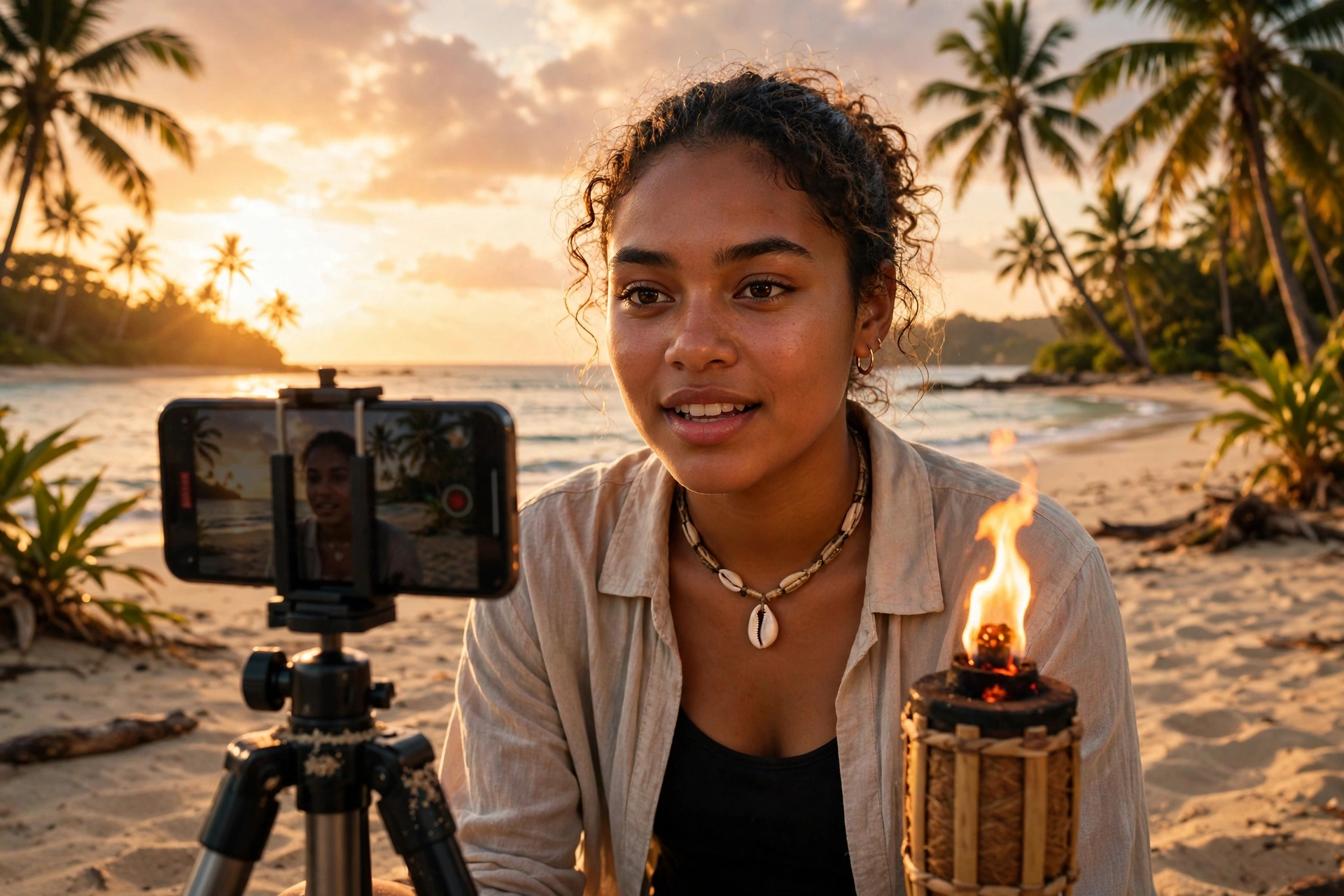
The most common failure is a video that sounds like a job interview for “strategist.” Casting director Jesse Tannenbaum’s advice, repeated across casting cycles, is authenticity over performance: do not script it, do not act, be yourself, and let your real life do the talking. Technically: film in landscape, keep it under three minutes and 50MB, use good light facing you, clear audio, and a quiet background. The videos that survive tend to do five things:
- Open in your real world, not your bedroom wall. Chefs get filmed in kitchens, farmers on farms, wrestlers in gyms. Your environment tells your story faster than your words.
- Show the contradiction. The prosecutor who quilts, the wrestler who cries at movies. Casts are built from people who are more than one thing.
- Talk like you talk. If you need a script, you are performing, and casting producers can tell within ten seconds. Notes are fine. Memorized lines are not.
- Say why you, why now. A life reason with stakes beats a game reason every time.
- End strong and keep it tight. Three focused minutes beat ten wandering ones, every single time.
Open Casting Calls: The Other Way In
CBS also runs open casting calls in select US and Canadian cities during application periods. At an open call, the casting team films your audition for you, so there is no need to shoot your own video first, and you can attend one in addition to submitting online. Bring a photo ID, bring your energy, and check the official casting portal for the current open call list before you travel. For many castaways, this was the door that opened.
Mistakes That End Applications Early
- Playing a character. Inventing a villain persona or copying a past player’s game. The callback exposes it immediately.
- Only talking strategy. A video that is all alliances and idols tells casting nothing about who you are at 6 a.m. with no food.
- Applying with conditions. Needing specific dates off, refusing parts of the game, or treating it as a holiday. Availability problems end more applications than personality does.
- Paying anyone. Again: casting is free, and paid “coaches” and “agents” for Survivor applications are not part of the process.
- Giving up after one no. The cast lists are full of people who applied for years. One rejection is the normal path, not the end of it.
When Is the Next Casting Window?
CBS opens casting in waves, usually while a season is airing or between seasons, and each window runs for a limited time on the official casting website. Survivor 52 will need a cast of its own, and the application window for it will be announced by CBS. When it opens, this page will be updated with the dates and the direct application details, and our Survivor 51 hub will carry the news.
How to Get on Survivor: FAQs
How do I apply for Survivor?
Through the official CBS casting portal, cbssurvivorcasting.com, when a window is open. The application is an online form plus a short audition video, or you can attend an open casting call in person. There is no other legitimate way in, and it costs nothing.
How old do you have to be to be on Survivor?
18 or older at the time you apply. The Survivor 51 cast ranged from 24 to 49, so there is no practical upper age limit for the right person.
How long should a Survivor application video be?
A maximum of three minutes, in a file under 50MB. Film it in landscape, with the light on your face, clear audio and a quiet room. Content beats polish: casting wants the real you, not a performance.
Do you get paid to be on Survivor?
Every castaway receives appearance money scaled to their finish, from a few thousand dollars for the earliest exits to $1,000,000 for the winner. Our Survivor 51 coverage breaks down the prize and the tax bill that comes with it.
How long are you away if you make the cast?
Plan for roughly six to eight weeks away from home with no contact, covering travel, pre-game sequester, up to 26 days of game, and post-game obligations.
Can Canadians apply for Survivor?
Yes. US and Canadian citizens and legal residents who can legally work in the United States are eligible, and Canadians appear in most modern casts, including two on Survivor 51.
What are my real chances of getting on Survivor?
Tens of thousands apply for about 21 places, so the honest answer is: slim in any single year, and much better across several years of applying with a stronger video each time. The process is built to find people, not to reward a single lucky submission.
This guide is maintained by Reality Trending and updated whenever CBS opens or announces a casting window. Last full check: October 14, 2026.