
Who Created Survivor? Charlie Parsons, Mark Burnett and CBS

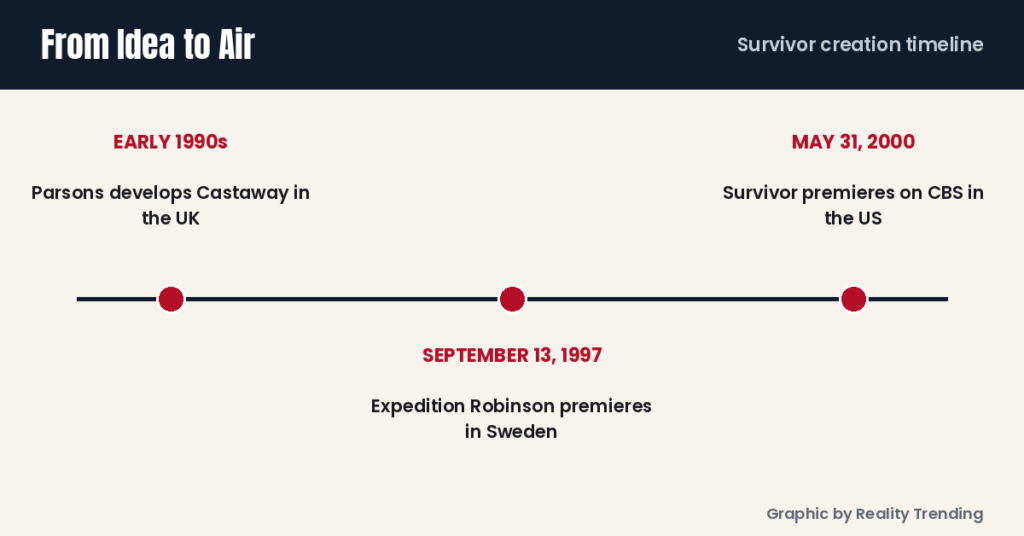
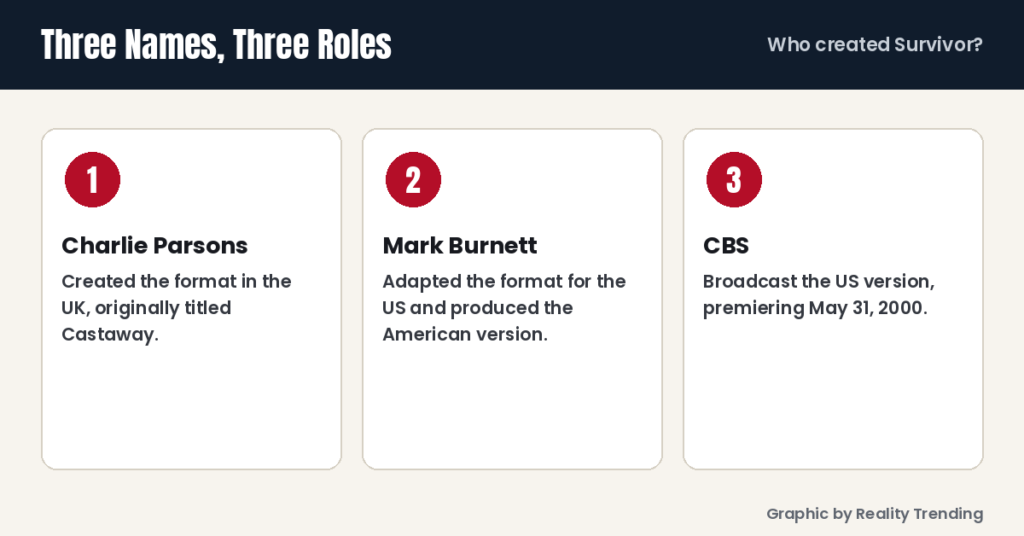
Survivor was created by British television producer Charlie Parsons. The show is based on Sweden’s Expedition Robinson, which Parsons developed and which first aired in Sweden in 1997. In the United States, producer Mark Burnett adapted the format for American television, and the US version premiered on CBS on May 31, 2000. So the short answer has three names, not one: Parsons created the format, Burnett brought it to America, and CBS put it on the air.
That distinction matters, because each man played a different role. Parsons invented the game. Burnett reshaped it for a US audience. CBS gave it the platform that turned it into a global hit. If you only credit one of them, you miss how Survivor actually came to exist.

The Survivor creator: Charlie Parsons
The survivor creator is Charlie Parsons, a British television producer. Parsons developed the format in the United Kingdom in the early 1990s through his production company Planet 24, which he formed with Bob Geldof. His original working title for the idea was Castaway.
The idea was simple and, at the time, radical for television. Strangers would be left in a remote location with very little help. They would have to find food, build shelter, and make fire for themselves. They would compete in challenges for rewards and for immunity from elimination. Then they would vote each other out, one by one, until a single winner remained.
British broadcasters did not buy it. Parsons tried to sell the idea in the UK, including to the BBC, but he could not get a commission. In interviews years later, he recalled broadcasters asking if he could make it as a documentary or as a short special instead of a full series. He refused, because he believed the format needed a long run so viewers could follow the social game as it developed.
Survivor based on Expedition Robinson: the Swedish original
Survivor based on Expedition Robinson is not a loose inspiration. Expedition Robinson is the original version of the international Survivor format, and the US show is directly derived from it.
After failing to sell the format in Britain, Parsons took it to Sweden. There, broadcaster SVT and production company Strix Television picked it up. Expedition Robinson premiered in Sweden on September 13, 1997. It was the first version of the format ever broadcast on television.
The Swedish show already contained the hallmarks that later defined Survivor. Contestants were marooned in a remote location. They were divided into tribes. They competed in challenges. Tribes eventually merged into one group. Players voted each other out at a council, and one winner remained at the end.
The first Swedish season was filmed in Malaysia, and Parsons later said the production team learned hard lessons from it. The contestants were given very little food, and the balance between genuine hardship and watchable television was not quite right at first. But the core game worked, and the Swedish audience responded strongly. Reports at the time described the first season finale as being watched by roughly half of Sweden’s population, a sign that the format had struck a nerve.
That success changed everything. Once Expedition Robinson had proved itself on air in Sweden, international versions became possible. The format was no longer just a pitch document. It was a working television show with an audience.
Who invented Survivor? Parsons, Burnett, and the US adaptation
So who invented Survivor? The honest answer depends on what you mean by “invented.” Charlie Parsons invented the format. Mark Burnett invented, or at least built, the American version of it. Neither story is complete without the other.
Burnett was also British, and he had already made a name for himself with Eco-Challenge, an adventure race series for cable television. He heard about Parsons’ castaway idea and wanted to bring it to the United States. According to Parsons, Burnett asked regularly about licensing the format, and Parsons turned him down more than once before finally agreeing.
Burnett did not simply copy the Swedish show. He retooled it. Accounts of the US development describe him as viewing the Swedish version as rougher and more mean spirited than what he wanted for American primetime. Drawing on his Eco-Challenge experience, he pushed for higher production values and for a stronger focus on the human drama of people under pressure, not just the physical hardship.
He then spent about a year trying to find a US broadcaster willing to take the show. That search ended at CBS. In late 1999, Burnett pitched the series to CBS executive Les Moonves, and CBS agreed to pick it up. The network scheduled it as a summer replacement series, a lower risk slot that turned out to be perfect timing. With little summer competition, Survivor had room to find an audience.
It is also worth clearing up a common mix-up here. Jeff Probst did not create Survivor. Probst was hired as host, and he has since become so closely associated with the show that many viewers assume he must have invented it. He did not. His role was to guide the game on screen, run Tribal Council, and explain the rules to viewers. The format itself came from Parsons, and the US production was led by Burnett. Probst’s contribution came later, as host and eventually as an executive producer, but the creation credit belongs to Parsons.
For more on Probst’s role in front of the camera, see our profile of Jeff Probst.
When did Survivor start? The US premiere and Survivor first season
When did Survivor start in the United States? The US version premiered on CBS on May 31, 2000. That date marks the start of the American series, even though the format itself had already existed in Sweden since 1997.
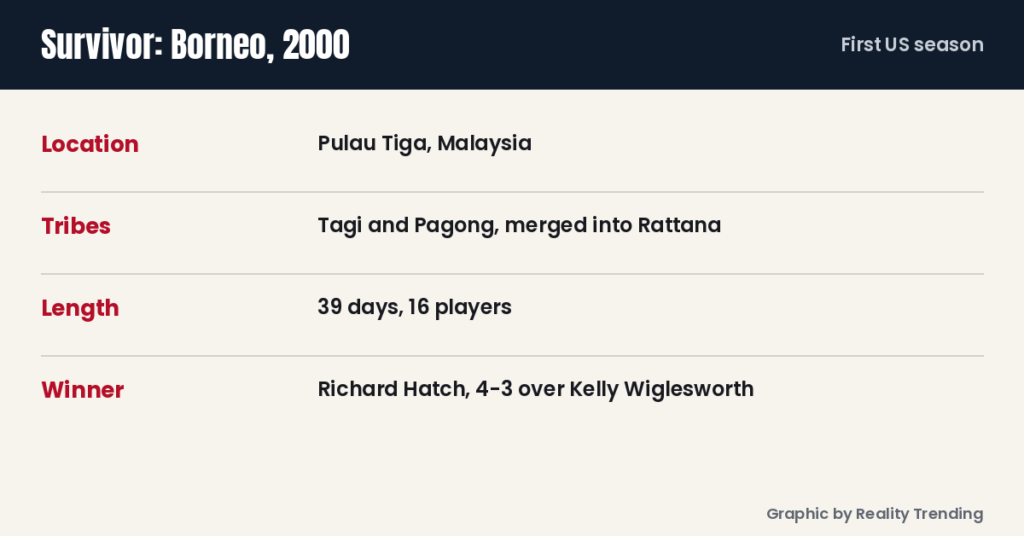
The survivor first season was called Survivor: Borneo, although it was originally broadcast simply as Survivor. It was filmed from March 13 through April 20, 2000, on Pulau Tiga, a remote island off the coast of Borneo in Malaysia. Sixteen contestants were divided into two tribes, Tagi and Pagong, named after the beaches where they camped. When ten players remained, the tribes merged into one tribe, Rattana.
The game lasted 39 days. Players built their own shelters, competed in reward and immunity challenges, and voted each other out at Tribal Council. The final seven eliminated players formed the jury, which chose the winner.
Richard Hatch won the first season, defeating Kelly Wiglesworth in a 4 to 3 jury vote. The finale aired on August 23, 2000, and it became a television event. Nielsen reported an average of 51.7 million viewers for the finale, the highest in the history of the franchise, with about 125 million people watching at least part of it. Those numbers are a big part of why Survivor was renewed again and again, and why it is still running more than two decades later.
The first season also established the prize that became a signature of the show: $1 million for the Sole Survivor. Later seasons added twists, advantages, idols, and new locations, but the basic structure from Borneo, tribes, challenges, merge, jury vote, has stayed at the center of the game.
Expedition Robinson vs US Survivor: what changed and what stayed the same
The US version kept the Swedish skeleton but changed the presentation. The table below shows the key similarities and differences.
| Feature | Expedition Robinson (Sweden, 1997) | Survivor (US, 2000) |
|---|---|---|
| Creator of the format | Charlie Parsons | Charlie Parsons (format), Mark Burnett (US adaptation) |
| First aired | September 13, 1997, on SVT in Sweden | May 31, 2000, on CBS in the United States |
| Original location | Malaysia | Pulau Tiga, Malaysia |
| Opening cast size | Strangers divided into two tribes | 16 contestants in two tribes, Tagi and Pagong |
| Core game | Survival, challenges, merge, votes, one winner | Survival, challenges, merge, Tribal Council votes, one Sole Survivor |
| Production style | Earlier, rougher reality production | Higher production values, with a stronger focus on human drama |
| Prize framing | A grand prize for the last player standing | $1 million for the Sole Survivor |
The most important thing the table shows is continuity. Burnett changed the polish, the pacing, and the storytelling, but he did not change the game. That is why the credit question has a layered answer. Parsons designed the game. Burnett adapted it. CBS broadcast it.
Who owns Survivor now?
A related question fans often ask is who owns Survivor today. The answer is different from who created it, because ownership changed hands years after the show began.
The international Survivor format was long controlled through Castaway Television Productions, the company associated with Parsons. In July 2017, Banijay Group acquired Castaway Television Productions from its owners, Charlie Parsons, Lord Waheed Alli, and Bob Geldof. That deal placed the Survivor format under Banijay’s distribution arm, Banijay Rights.
So, in simple terms: Charlie Parsons created the format, and Banijay Entertainment now owns the international Survivor format. That ownership covers the format rights that are licensed to broadcasters and producers around the world. It does not mean Banijay makes every local version itself. Local versions are still produced by local production companies under license, and in the United States the show airs on CBS.
This is also why the show has spread so widely. A format owner can license the same game to many countries at once, while each country adapts casting, hosting, and locations for its own audience. For a look at how that worked outside the United States, see our guide to Survivor international versions.
The US show itself has continued under changing production arrangements over the years, with companies including CBS Studios and MGM Television listed among its production companies in different periods. The network, however, has stayed constant. From Borneo in 2000 to the present day, the American Survivor has been a CBS show.
Why the creation story still matters
Survivor is often called a pioneer of modern reality television, and the creation story explains why. Before Survivor, reality programming on US primetime was limited. After the Borneo finale drew more than 50 million viewers, networks rushed to develop their own unscripted competition shows. Survivor proved that ordinary people, placed in an unfamiliar situation and filmed over weeks, could carry a primetime series without a script.
It also proved that a format could travel. A British idea, first produced in Sweden, adapted by a British producer living in America, and broadcast by a US network, became a franchise shown around the world. That path, from one country’s gamble to a global format, is now standard in television. In 1997, it was still unusual.
For today’s viewers, the story is a useful reminder when watching the newest season. The twists change. The locations change. The cast changes every season. But the game underneath, strangers surviving together, competing, and voting each other out, is the game Charlie Parsons designed in the early 1990s and Sweden first put on television in 1997. Mark Burnett gave that game its American shape, CBS gave it its American home, and the audience did the rest.
If you want to see how far that game has come, start with the current season on our Survivor 51 Hub, then look back at Borneo. The production is bigger now, the strategy is more complex, and the players arrive knowing the game far better than the first cast did. The question at the center, though, is exactly the same: who can outwit, outplay, and outlast everyone else?
Who created Survivor?
Survivor was created by British television producer Charlie Parsons. He developed the format in the United Kingdom in the early 1990s through his company Planet 24, originally under the working title Castaway.
Who invented Survivor, Parsons or Burnett?
Charlie Parsons invented the format. Mark Burnett adapted it for the United States and produced the American version. Parsons created the game, Burnett brought it to US television, and CBS aired it.
When did Survivor start?
The Swedish original, Expedition Robinson, started on September 13, 1997. The US version of Survivor started later, premiering on CBS on May 31, 2000.
What was the Survivor first season?
The first US season was Survivor: Borneo, filmed on Pulau Tiga in Malaysia. It featured 16 contestants in two tribes, Tagi and Pagong, lasted 39 days, and was won by Richard Hatch in a 4 to 3 jury vote over Kelly Wiglesworth.
Is Survivor based on Expedition Robinson?
Yes. Survivor is based on Expedition Robinson, the Swedish series created by Charlie Parsons. Expedition Robinson was the first televised version of the format, and the US Survivor is directly derived from it.
Who owns Survivor?
Banijay Entertainment owns the international Survivor format. Banijay Group acquired Castaway Television Productions, the company behind the format, in July 2017 from Charlie Parsons, Lord Waheed Alli, and Bob Geldof. In the United States, the show continues to air on CBS.