Survivor International Versions: Every Major Edition Worldwide

If you only watch the American show, it is easy to assume Survivor began in the United States. It did not. The format began in Sweden and has since been remade with local casts, hosts, languages, and twists in dozens of countries. So, how many countries have Survivor in one form or another? The honest answer depends on how you count, because some editions are shared across borders, some use a different local title, and some have come and gone. The format owner, Banijay, reported in 2022 that Survivor had been commissioned in 50 territories. That reported figure supports the shorthand of “more than 40 countries,” but it is best read as territories commissioned, not as 50 editions all airing at the same time.

Where Survivor Really Began
The Survivor format was developed by British television producer Charlie Parsons for Planet 24, a United Kingdom production company. The first version to reach television was Sweden’s Expedition Robinson, which debuted in September 1997. Its title nodded to Robinson Crusoe and The Swiss Family Robinson, stories about people marooned after a shipwreck. That core idea, strangers stranded in a remote place, forced to build shelter, find food, compete in challenges, and vote each other out, became the template for everything that followed.
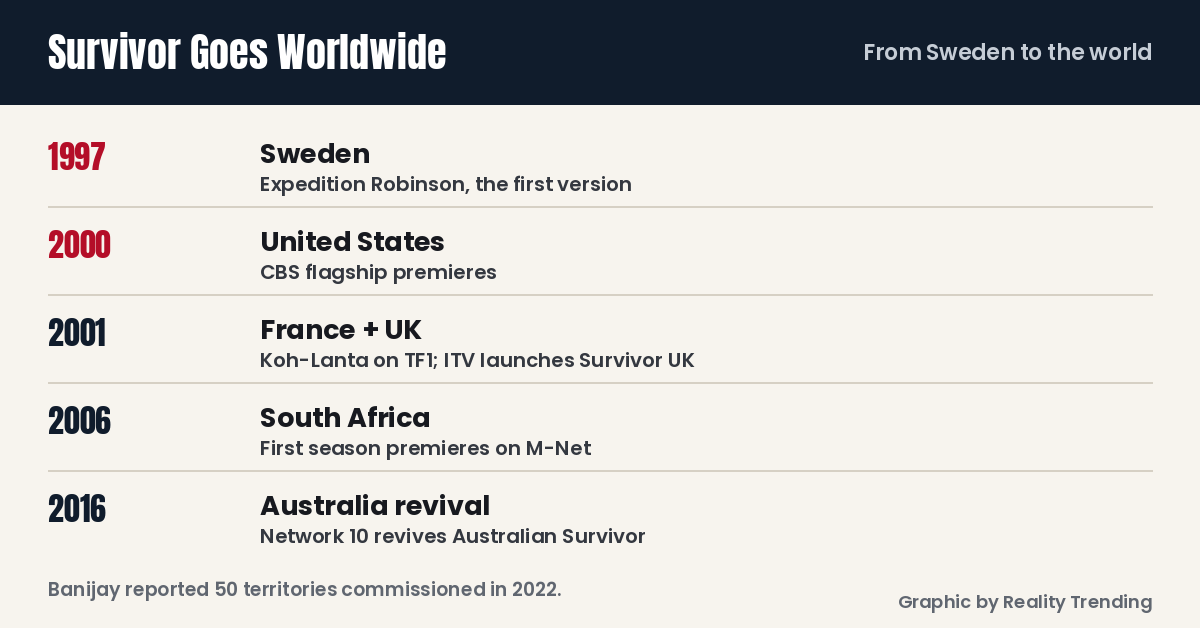
The American version premiered on CBS in 2000 and became the flagship edition for most English speaking viewers. Early adaptations kept the Robinson name in several markets, while others adopted the Survivor name made famous by the American show. If you want the full backstory, start with who created Survivor, and for the places the American show has used, see where Survivor is filmed.
One distinction matters throughout this guide. “Aired in a country” and “made in a country” are not the same thing. The American show has been broadcast in far more places than the number of countries that have produced their own local cast. When this article says an edition exists, it means a local version was produced for that country or region.
Australian Survivor: The Leading Edition Outside the US
For many international fans, Australian Survivor is the second flagship of the franchise. Its history is unusual because it has aired on all three major Australian commercial networks at different times.
The first Australian season premiered on 13 February 2002 on the Nine Network, with Rob Dickson winning that season. A celebrity edition followed on the Seven Network in 2006, won by Guy Leech. Neither early run lasted, but Network 10 revived the format in 2016. That revival, hosted for its long Network 10 run by Jonathan LaPaglia, became a yearly event.
The Network 10 seasons developed their own identity, with themes such as Champions v Contenders, Brains v Brawn, Blood v Water, Heroes v Villains, and Titans v Rebels. The 2016 revival season was won by Kristie Bennett, and later winners included Shane Gould, Pia Miranda, David Genat, Hayley Leake, Mark Wales, and Liz Parnov. The Australian prize has typically been A$500,000, half the American cash prize, but the seasons are often longer, with more episodes and a larger cast than the modern American format.
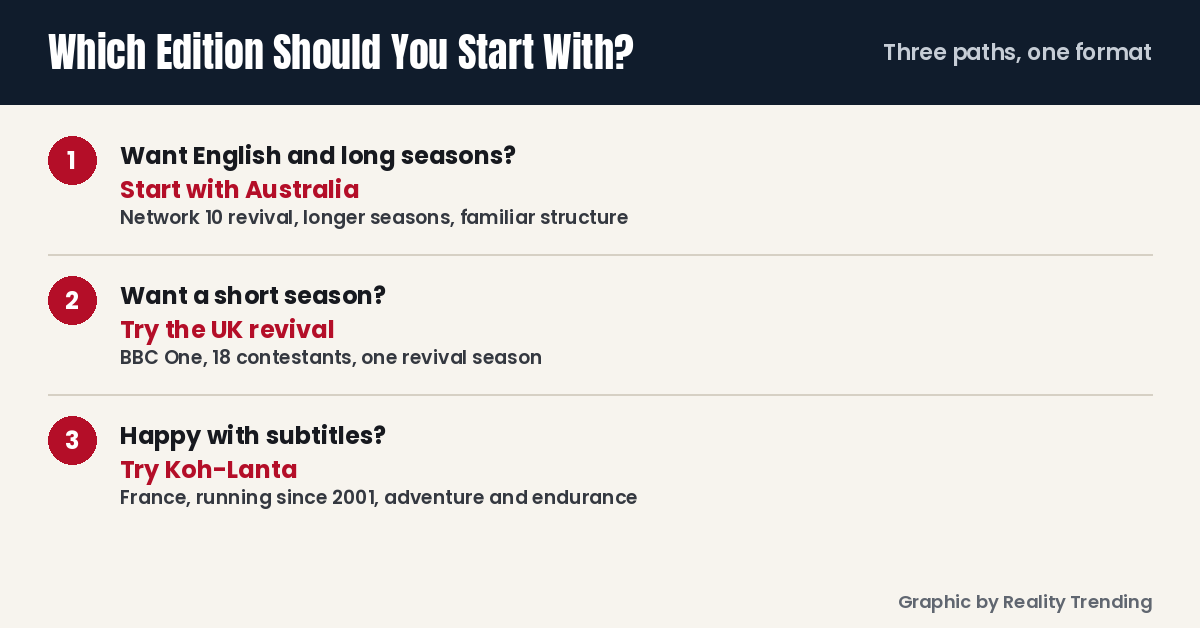
If you are an American viewer looking for one international edition to try first, Australian Survivor is the easiest recommendation. It is in English, it follows a familiar structure, and its longer seasons give it a different rhythm from the CBS show.
Survivor UK: Two Launches, Two Very Different Eras
The United Kingdom has launched Survivor twice. The original British version aired on ITV in 2001 and 2002, running for two seasons before ITV cancelled it. Later histories agree that the show was not a ratings disaster in absolute terms, but it failed to build the loyal audience ITV wanted, and the network admitted it had not supported the launch well enough, especially in scheduling.
More than two decades later, the BBC revived the format. The revival was announced in September 2022 and premiered on 28 October 2023 on BBC One and BBC iPlayer, hosted by Joel Dommett. The BBC season featured 18 contestants competing for a reported £100,000 prize and the title of Ultimate Survivor, with filming in the Dominican Republic. It found a stronger second life on iPlayer catch up than in overnight ratings, but reports in 2024 said the BBC had shelved the show after one revival season, with applications for a further series paused. That stop start history is a reminder that a strong format does not guarantee a long run in every market. Scheduling, audience habits, and broadcaster patience matter as much as the game itself.
Survivor South Africa: A Long Running Edition With Local Identity
Survivor South Africa is a strong example of a local edition that kept the format’s heart while building its own traditions. It began on M-Net, with its first season, set in Panama, premiering on 3 September 2006. That first season was hosted by Mark Bayly. Nico Panagio later became the long running host, taking over from the third season onward.
The South African edition has not aired every year. It has returned in bursts, with seasons set in places including Panama, Malaysia, Mozambique, the Maldives, the Philippines, Samoa, and South Africa itself. Its eighth season, Immunity Island, was filmed on South Africa’s Wild Coast and aired in 2021, after pandemic disruption forced production to stay local. The location changed, but the game, tribes, challenges, and Tribal Council structure stayed recognisable.
South Africa also produced a pan regional edition, Survivor Africa, in 2006, featuring contestants from several African countries. That shared edition is one reason country counts get complicated. One production can cover Botswana, Ethiopia, Ghana, Kenya, Namibia, Nigeria, Zambia, and Zimbabwe, but it should not be counted as eight separate national editions.
France: Koh-Lanta, the Edition That Kept Its Own Name
France proves that a Survivor edition does not need the Survivor name to succeed. Its version is called Koh-Lanta, named after the island location of its first season, and it has been broadcast on TF1 since it premiered on 4 August 2001. Denis Brogniart has hosted the show since its second season, after Hubert Auriol hosted the first.
Koh-Lanta follows the familiar premise: contestants are marooned, must provide food, water, fire, and shelter for themselves, compete in challenges for rewards and immunity, and are voted out one by one until a winner remains. The grand prize has been €100,000. The French edition is also known for its own twists, including versions of the Black Vote idea, in which a voted out player can cast an extra vote affecting the next Tribal Council. It has also had seasons with tied final votes resulting in joint winners, which is rare in the American format.
Because Koh-Lanta has run for so many seasons, it has become part of national television culture. French viewers do not think of it as “the French Survivor.” They think of it as Koh-Lanta, a show in its own right. That is the goal for any successful adaptation: the format disappears, and the local version feels native.
Other Major Editions Worth Knowing
Norway followed Sweden early with Robinsonekspedisjonen, which began in 1999, and the Netherlands launched Expeditie Robinson on 15 September 2000, a version also broadcast in the Flanders region of Belgium. In Asia, the Philippines produced Survivor Philippines on GMA Network, with its first season in 2008 and a celebrity edition following in 2010. Israel’s version, Hisardut, began in December 2007 and aired first on Channel 10 before later moving to Reshet. India has had both a Hindi edition, Survivor India on Star Plus, and a Tamil edition, Survivor Tamil on Zee Tamil, which premiered in September 2021.
In the Pacific, Survivor NZ ran for two seasons on TVNZ 2, premiering on 7 May 2017 and ending in July 2018. Its first season was filmed in Nicaragua, its second in Thailand, and its prize rose from NZ$100,000 in season one to NZ$250,000 in season two. Turkey, Brazil, Denmark, Finland, Spain, and several other countries have also produced local versions, some under the Survivor name and some under local titles such as Brazil’s No Limite. The exact list changes over time as editions launch, pause, or return, which is another reason to treat any single country count as a snapshot, not a permanent total.
Major Editions Compared
| Country or region | Local title | Network | Note |
|---|---|---|---|
| Sweden | Expedition Robinson (later Robinson) | SVT (original run) | First televised version, debuted September 1997 |
| United States | Survivor | CBS | Flagship edition, premiered 2000 |
| Australia | Australian Survivor | Nine, Seven, then Network 10 | Revived by Network 10 in 2016, prize typically A$500,000 |
| United Kingdom | Survivor (Survivor UK) | ITV, then BBC One | ITV run 2001 to 2002, BBC revival premiered 28 October 2023 |
| South Africa | Survivor South Africa | M-Net | First season premiered 3 September 2006, later hosted by Nico Panagio |
| France | Koh-Lanta | TF1 | Premiered 4 August 2001, prize €100,000 |
| Netherlands and Flanders | Expeditie Robinson | RTL (Netherlands) | Debuted 15 September 2000 |
| Philippines | Survivor Philippines | GMA Network | First season 2008, celebrity edition followed |
| Israel | Hisardut (Survivor) | Channel 10, later Reshet | Began December 2007 |
| New Zealand | Survivor NZ | TVNZ 2 | Two seasons, 2017 to 2018, filmed in Nicaragua and Thailand |
| Norway | Robinsonekspedisjonen | TV3, later TV2 | Began 1999, one of the earliest adaptations |
Networks listed are the main original broadcasters. Some editions have moved networks over time.
What Stays the Same, and What Changes
Every major edition keeps the same skeleton. Strangers are divided into tribes, they must survive with limited supplies, they compete for reward and immunity, and they vote each other out at Tribal Council until one Sole Survivor (or, in the UK revival, Ultimate Survivor) remains. Hidden immunity idols, tribe swaps, merges, and jury votes appear in most versions, even if the exact rules differ.
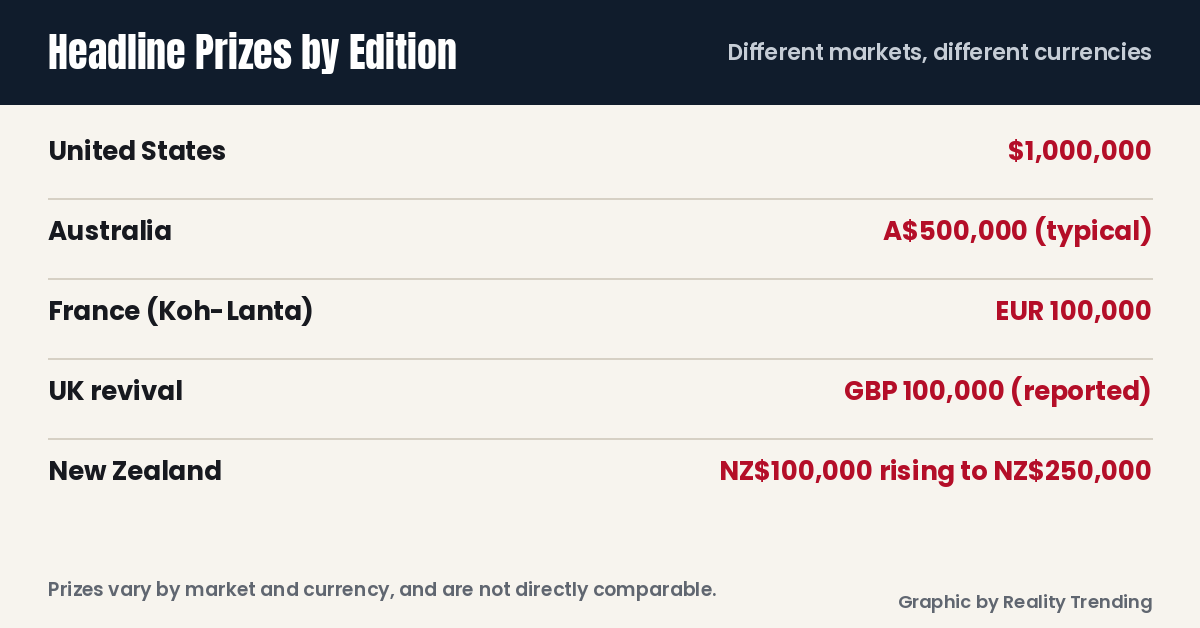
What changes is often more interesting. Season length varies widely: American seasons are now shorter and faster, while Australian seasons are longer. Prizes vary by market and currency: the American prize is $1 million, Australia’s is typically A$500,000, the UK revival offered a reported £100,000, France offers €100,000, and New Zealand’s prize rose from NZ$100,000 to NZ$250,000. Twists also travel unevenly. TV Insider’s comparison of global versions notes paired fates (sometimes called Tied Destinies), in which two players share rewards, immunities, and elimination, and the Black Vote, in which a voted out player casts one final secret vote. Cultural tone changes too: American Survivor leans into strategy talk, Australian Survivor leans into longer, more physical gameplay, Koh-Lanta leans into adventure and endurance, and Survivor South Africa leans into local landscapes and casting.
Availability varies by country and streaming service, and it changes often as rights move, so check your local broadcaster or streaming catalogue before settling on a season.
The Bottom Line
Survivor is not just an American show with a few foreign copies. It is a format that began in Sweden, was shaped in the United Kingdom, exploded in the United States, and then returned to the world in dozens of local forms. The “more than 40 countries” figure is a fair summary, provided you understand it as a reported count of territories commissioned, not a list of editions all airing right now. Some editions, such as Australian Survivor and Koh-Lanta, have become institutions in their own countries. Others, such as Survivor NZ and the original UK run, burned brightly for a short time and ended. All of them prove the same point: the core game, outwit, outplay, outlast, translates across languages, climates, and cultures, because it is really a game about people.
How many countries have Survivor?
Survivor has been commissioned in a reported 50 territories, according to format owner Banijay in 2022, which supports the shorthand of more than 40 countries. The exact number depends on counting rules, because some editions are pan regional, some share a production across borders, and some editions have ended. It is best described as dozens of countries and territories, not as a fixed number of shows airing at once.
What was the first international version of Survivor?
The first televised version was Sweden’s Expedition Robinson, which debuted in September 1997. It was based on a format developed by British producer Charlie Parsons. The American version, which premiered in 2000, came later and became the best known edition worldwide.
Is Australian Survivor the same as American Survivor?
Australian Survivor uses the same core format: tribes, challenges, Tribal Council votes, and a Sole Survivor winner. It differs in season length, episode count, casting themes, and prize money, which has typically been A$500,000. Its Network 10 revival began in 2016 after earlier runs on Nine Network in 2002 and Seven Network in 2006.
Why is the French version called Koh-Lanta instead of Survivor?
Koh-Lanta is France’s local title for the Survivor format, named after the island location of its first season. It premiered on TF1 on 4 August 2001 and has been hosted by Denis Brogniart since its second season. Local titles are common in this franchise, especially in markets where the format arrived under a Robinson style name.
Did Survivor UK get cancelled?
Survivor UK aired on ITV in 2001 and 2002 before being cancelled. The BBC revived it on 28 October 2023, but reports in 2024 said the revival had been shelved after one season, with applications for a further series paused. No new BBC series should be assumed until the BBC confirms one.
Which international Survivor should a new viewer start with?
Australian Survivor is the best first choice for English speaking viewers, because it is long running, familiar in structure, and widely discussed by international fans. Survivor UK’s BBC revival is a good shorter option, and Koh-Lanta is the best subtitled option for viewers who want a long running, distinctive edition.